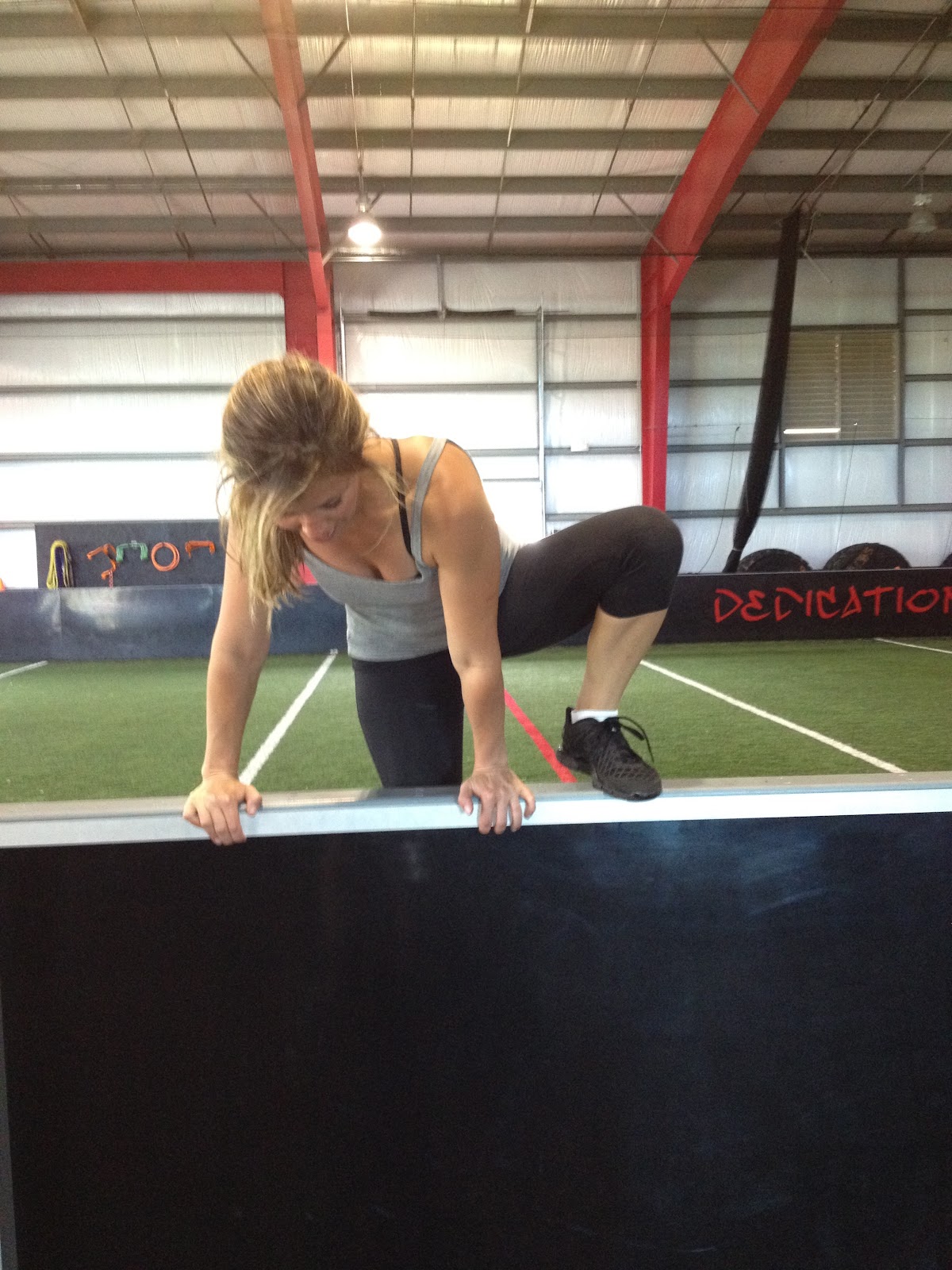
Think about climbing over a fence when you were young. When was the last time you did that? Its actually a great whole body exercise! Here's a great exercise that works the arms, core, legs and is sure to get your heart rate up! Simply just find a half wall or a bench works well too. Place your hands on the bench and supporting your weight with your arms jump over the bench. Land w/ knees bent and do not let hands leave bench. Go back and forth for desired reps and sets. If you do have half wall as seen in picture, simply climb up and over and repeat for reps and sets. I use this often in my shoulder and knee rehab when the patient is past the acute and subacute phases of tissue healing and is ready to progress to more advanced ex to prepare them to return to work or sport. Construction workers, police, military and fire personnel all climb and jump over things. So, I need to prepare them and make sure they are ready to go and confident in their physical abilities. This in essence is truly functional training/rehab. Using the bench is an easy alternative and less demanding for those not ready or able to climb a wall. I always try to think of all the ways my pts will utilize their bodies in their sport, work or recreational activities and progress them to activities and movement that replicate that.
Get Strong! Stay Strong!
Chris
Showing posts with label core. Show all posts
Sunday, October 7, 2012
Sunday, January 29, 2012
Kettlebells for Back Pain
Turning to Kettlebells to Ease Back Pain
By ANAHAD O'CONNOR - NY Times
Stephanie Diani for The New York TimesA kettlebell workout may be just the thing to ease back, neck or shoulder pain.
Kettlebells, cast-iron weights that have been used for centuries to train Russian soldiers and athletes, appear to be a promising therapy for back and neck pain, new research shows.
Although many people with backaches and other pains shy away from weight lifting for fear of hurting themselves, studies show that strength training can reduce pain and prevent reinjury. While most research has used traditional weight training exercises, researchers in Denmark set out to study whether a kettlebell workout offered therapeutic benefits to back pain sufferers.
The weights, named for their resemblance to a tea kettle with a looped handle, began showing up in American gyms about 15 years ago and have gained a popular following among exercise buffs looking for a quick full-body workout. Unlike traditional weight training, which typically focuses on lifting exercises, a kettlebell workout requires both swinging and lifting of the weights, which for beginners can be awkward and difficult to control.
In a study published last year, the Danish researchers recruited 40 pharmaceutical workers, mostly middle-aged women with back, shoulder and neck pain, who were randomly assigned to either a regular kettlebell workout or a control group that was simply encouraged to exercise. The first group trained with kettlebells in 20-minute sessions two to three times a week for eight weeks, according to the report, published in The Scandinavian Journal of Work, Environment & Health.
At the end of the study, the kettlebell exercisers reported less pain as well as improved strength in the trunk and core muscles, compared with the control group. Over all, working out with kettlebells reduced lower back pain by 57 percent and cut neck and shoulder pain by 46 percent.
The study’s senior author, Lars L. Andersen, a government researcher in Denmark, noted that workers who spend much of the day sitting are particularly vulnerable to back, shoulder and neck pain because they develop tightness and weak spots along the posterior muscle chain, which includes the muscles running from the lower back down to the glutes, hamstrings and calves. Kettlebell workouts strengthen the posterior muscle chain, and the increased blood flow to the back and leg muscles also may lessen pain by reducing the buildup of lactic acid, the authors wrote.
While isolation exercises like curls and presses have their benefits, kettlebell movements recruit multiple muscles and teach the body “to move as one unit,” said J.J. Blea, a certified kettlebell instructor and an owner of Firebellz in Albuquerque, one of the top kettlebell gyms in the country.
Because kettlebells can be difficult to control, it’s important to learn proper form from a certified instructor or a kettlebell class at a gym. The cornerstone of the kettlebell workout requires the exerciser to swing the kettlebell between the legs. In the Danish study, women started with a 17.5-pound kettlebell and men with a 26.5-pound kettlebell.
“When you’re doing a swing, you squeeze your quads, you squeeze your glutes, and you squeeze your abs,” said Mr. Blea. “By squeezing these muscles, you protect your back. It creates power, and it increases strength.”
Kettlebell training is also surprisingly aerobic. A study by the American Council on Exercise found that a 20-minute kettlebell workout burns about 21 calories a minute, the equivalent of running at a six-minute-mile pace.
Get Strong! Stay Strong!
Chris
Friday, January 27, 2012
Back Pain? Then Read This Now
Millions of Americans suffer from low back pain each day. This can range from minor aches and stiffness to severe debilitating pain and spasm. There are many disorders such as degeneration, spurring, bulging and prolapsed discs, pinched nerves and fractures, which are the result of what we do (or don’t do) to our bodies day in and day out. So, the question you should ask is; what can I do to prevent back pain or at least reduce my risk? Simply stated, just get up off your butt. While simple, it is true. Too many people have become sedentary. Many jobs require hours of sitting, driving or flying, Technology has created an environment in which you don’t even have to move to be part of it. Adults and children are lulled into inactivity with television and video games. Schools are also taking part by eliminating physical education from many curriculums. Most people we see with back pain are deconditioned, have tight calves, hip flexors and chest muscles, weak hip and trunk muscles, rounded shoulders and poor abdominal integrity. And then, the ones who do exercise do exercises like sit ups which add to the spinal stress. Inactivity (exercise), poor nutrition and aging are a potent recipe for many ailments. Now, there are specific exercises for the core. I advise you to see a qualified physical therapist to evaluate and instruct you in the best exercises for you. In general, some useful tips for the “health” of your back include, but are not limited too: Drink plenty of water, many joint problems can be minimized with proper hydration (most Americans are chronically dehydrated). Utilize a lumbar or towel roll in low back to maintain good sitting posture, don’t sit for prolong periods, get up and stretch frequently. Get in shape with general exercise, lose those unwanted pounds. Avoid bending over for the first hour upon waking because your discs are more “swollen” due to reabsorbing water through the night. As a result, you are more prone to a back injury in that first hour. When at the sink, open cupboard and place foot on ledge. Now when you bend over to brush teeth or wash face you will bend more at hip and less from the low back.
Get Strong! Stay Strong!
Chris
Labels:
abdominal exercise,
chris kolba,
core,
core training,
D1,
exercise,
herniated disc,
hip mobility,
low back pain,
lumbar roll,
physical therapy,
sciatica,
sports medicine
Subscribe to:
Posts (Atom)

